
The Supreme Court is being urged to dismantle a “criminal trap” reportedly used to snare political enemies.
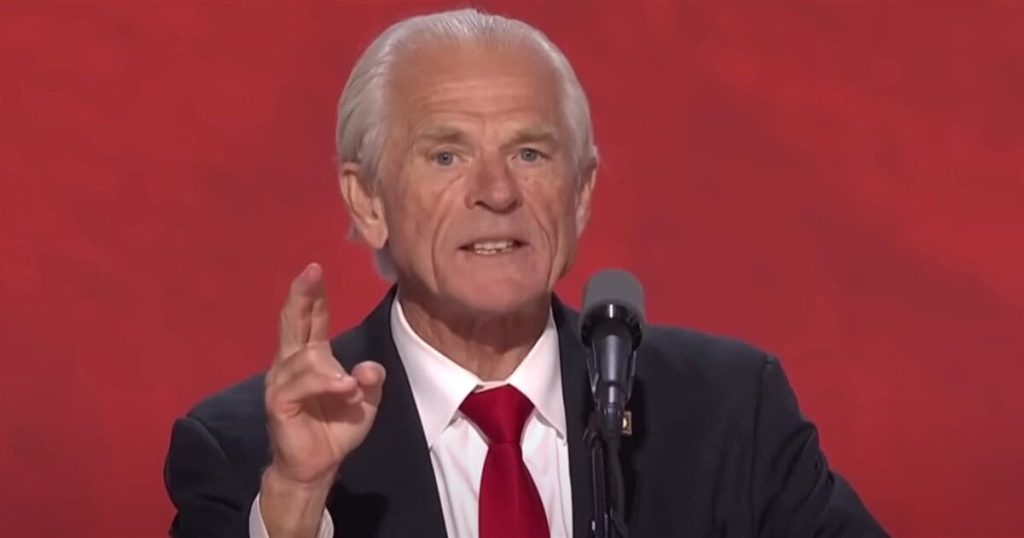
Former Trump administration official Peter Navarro, who served four months in federal prison for defying a congressional subpoena, is asking the Supreme Court to overturn his convictions.
The case could make it harder for the government to criminally prosecute people who refuse to comply with Congress’ demands.
Navarro, who served as a senior trade adviser during President Donald Trump’s first term, filed the petition with the Supreme Court last month, Fox News Digital reported. He currently holds the role of senior counselor for trade and manufacturing in the Trump administration. In 2023, he was convicted on two counts of contempt of Congress after refusing to testify or turn over documents to the Democrat-led House January 6 committee, arguing that he was protected by executive privilege.
Peter Navarro asks the Supreme Court to overturn his contempt of Congress convictions in a case that could make such prosecutions harder to prove.
https://t.co/L8VNKXANLl https://t.co/S6N95bBIFa— Drew Grimaldi (@Grimillionaire) November 19, 2026
Navarro’s request could make it harder to convict someone for not complying with a congressional subpoena, if SCOTUS takes the case.
“Before Navarro’s trial, U. S. District Judge Amit Mehta ruled in August 2023 that he had failed to establish that Trump invoked executive privilege for the subpoena, barring him from relying on that claim as a defense,” Fox Digital reported. “After serving his sentence, Navarro appealed his conviction to the U. S. Court of Appeals for the D. C. Circuit, which ruled that a person violates federal law by refusing to comply with a subpoena ‘even if he subjectively and mistakenly believed his default was lawful.’”
“The three-judge panel ruled that only the president can invoke executive privilege under Article II, and Trump never granted Navarro protection,” Fox Digital continued.
“Dr. Navarro claimed executive privilege before even seeing the subpoena and refused to turn over documents, appear for his deposition, or engage with the Select Committee’s efforts to accommodate his privilege claim,” the court wrote, according to Fox.
“A court, in other words, cannot simply take a defendant at his word that the President invoked privilege because doing so would impermissibly tangle separation-of-powers lines.”
Navarro’s counsel, Abhishek Kambli, criticized the D.C. Circuit’s ruling and argued for the case.
“We absolutely believe that we are correct on the law on this, because Congress chose to use the word willful when it put this statute together, and there’s no reason to believe that willful applies any differently in this context than it has in just about every other one, but it would have the added effect of toning down lawfare and weaponization if we were to succeed,” Kambli told Fox News Digital.
“When it comes to executive branch officials, there was an accommodation process where they would negotiate terms of the appearance of the witness that’s an executive branch official, and then determine whether executive privilege applies or not,” Kambli continued. “What happened with the J-6 committee is that they short-circuited a lot of that and sent people straight to getting prosecuted and indicted.”
Kambli believes a favorable SCOTUS ruling for Navarro could “tone down the weaponization that could potentially occur” when Democrats take control of Congress.
“What would happen is that if we were to win and the correct mental state is required to prove someone violated this law and get convicted and sent to jail, you would have fewer prosecutions for contempt of Congress because they’re going to be much harder to prove,” Kambli told Fox News Digital.
“And what will happen is that there’s less of an opportunity to wield a congressional subpoena in a weaponized manner rather than just through a legitimate legislative purpose, which Congress is limited to traditionally.”