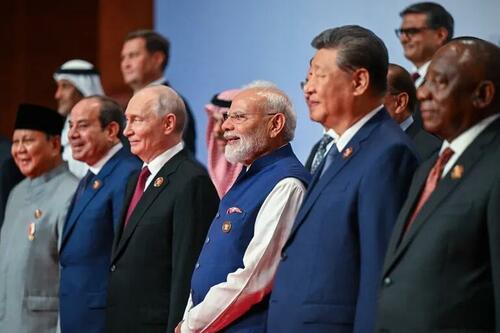
BRICS Steps Off The Dollar, With Iran Pressing Hardest Authored by former CIA officer Larry Johnson The 18th BRICS summit opened on Saturday with the bloc taking its most concrete step yet toward loosening the grip of the US dollar, adopting a 45-page New Delhi Declaration on the first day and endorsing a payments architecture built to route cross-border trade around the Western financial system. For most members the move was incremental. For Iran — under sweeping US sanctions, a naval blockade, and roughly six months into a war with the United States and Israel — it was closer to a lifeline. The declaration and the payment rails Leaders gathered at the Bharat Mandapam convention center adopted the New Delhi Declaration 2026 unanimously on the opening day, with Prime Minister Narendra Modi emerging from a closed session to report that no member had objected to the text. The economic centerpiece was a commitment to expand trade and investment settled in members’ own national currencies, and to link their domestic payment and messaging systems so that transactions can move without passing through the dollar-denominated SWIFT network. According to the declaration, the bloc’s payment task force had studied cross-border interoperability of those channels and examined using local currencies for trade settlement and investment. The mechanism drawing the most attention was BRICS Pay, a decentralized payment-messaging framework that stitches together India’s UPI, China’s CIPS, and Russia’s SPFS into a shared interoperability layer — a way to clear payments among members outside SWIFT. The declaration also referenced a pilot for a gold-backed “Unit” token. During 18th BRICS Summit in New Delhi on September 13, 2026, Indian Press Information Bureau via AFP Just as telling was what the bloc again declined to do. There was no endorsement of a single common BRICS currency; India in