Says Iran ‘Not an evil regime’
Please follow us on Gab, Minds, Telegram, Rumble, Truth Social, Gettr, X, Youtube, Instagram
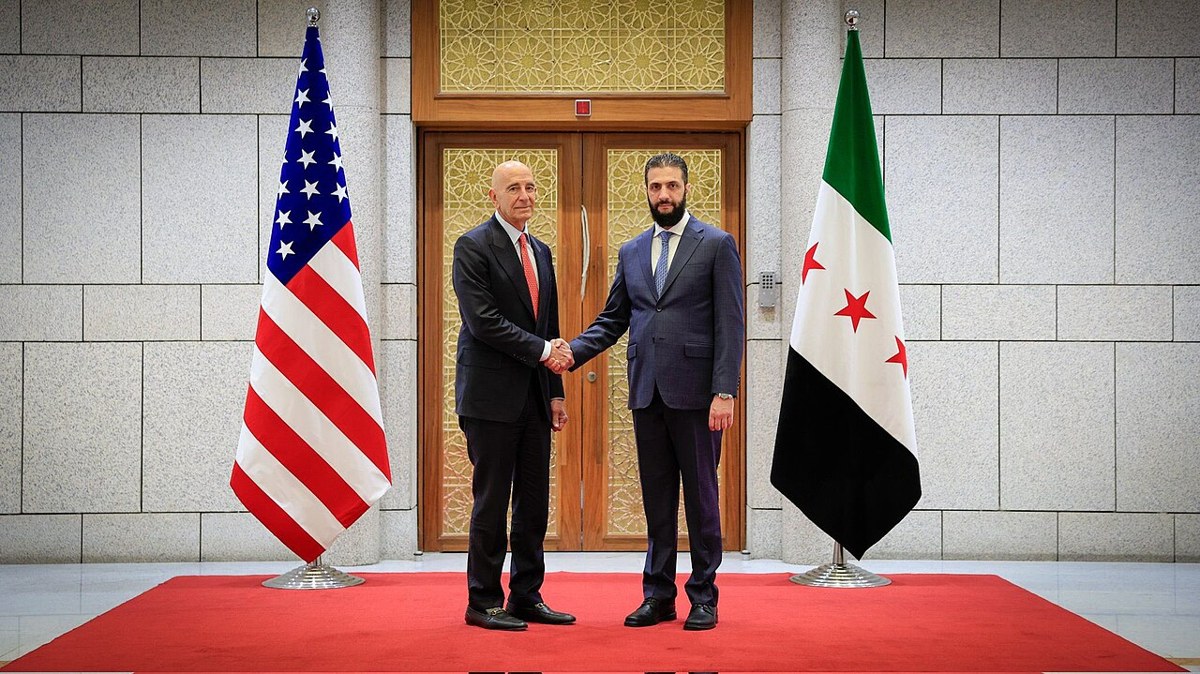
US Ambassador to Türkiye Tom Barrack, who also serves as the U.S. Special Envoy for Syria, told the Global Security Forum in Doha on Tuesday that Washington is done trying to manage the Middle East and admitted that the old arrangement had in fact served the interests of the West. Videos exist of the speech online.
Tom Barrack, U.S. Ambassador to Türkiye, on Tuesday: “Very little antisemitism, even in the region. The Jews existed side by side forever. Zionism in ’48 became another issue.”
Barrack on Sykes-Picot, the 1916 British-French agreement: “Nation-states don’t really work, and I get in trouble every time I say this. Sykes-Picot took this region and imposed boundaries over tribes and religions that never were bound by that geography.”
“Whatever we did in the Middle East, hopefully, a lot of it was beneficial, and a lot of it was not. Conflict and controversy were actually in the West’s favor. The more off-balance the region was, the more the West could manipulate fossil fuels for its own benefit. That’s not in existence anymore. So, owning doesn’t work, and controlling hasn’t worked.”
Barrack further explained how the US no longer wants to own the region. “The bargain is not to control, but to not leave. We’re not leaving,” he said. In the context of regime change, he added that the US had been involved in 23 regime changes across the wider Middle East. “Every time we try and intervene, change the person or the regime, it seems to have been a mistake,” he said.
“America’s not leaving. America is tending. It’s just not trying to control. Controlling hasn’t done very well. Allowing Qatar to be Qatar, allowing the region to be the region is, I think, the key.”
On Iran, Barrack said: “If you look at Iran, the Iranian people we all love and adore, and understand that the Shia Twelver philosophy, from the ground up since 1979, is a theocracy. It’s not an evil regime; that has nothing to do with it. That’s a religious content and practice that we all respect. The IRGC has become an adversary, and the IRGC and its adversarial role with Israel has been a problem.” He declared Iran’s future should be left to the Iranians.
On terrorist groups and sanctioned entities, Barrack said: “If you want terrorists, or state-sponsored terrorism, or any of these sanctioned entities to proceed to something, what do they proceed to? Either you say, ‘I’m going to eliminate all of them. Anybody who ever went on this list, I’m just going to eliminate.’ That’s not a very good solution. And you’re not going to convince any adversarial to come to your side if you don’t have a path to prosperity for them.”
On what America should do next, Barrack said: “America has to do a better job of defining, ‘Here’s what we’re willing to do, here’s what we’re not willing to do, but you are the creators of your own destiny.'”
On Saudi Arabia and the Houthi fighting in Yemen, Barrack said: “I think Saudi Arabia is in a very difficult position. Look, the history of Yemen, and, you know, I’m not about to teach the region who understands it. These kinetic reactions have never worked. It doesn’t work. It’s probably not likely that it’s going to work.”
He added that President Trump stands with Riyadh, but only so far. “I think Trump has been clear that he supports Saudi Arabia, and the backing that they need logistically, he will supply. But America getting involved in a ground, kinetic battle somewhere else seems fruitless.”
He noted that no amount of divine intervention has ever solved the long-standing problems of this region of the world. By his count there have been 55 Christian prophets, more than 100 Islamic prophets and another 50 Jewish prophets in this region over the centuries, and none of them have ever been able to solve the problems of this area.
“If we look at how many prophets were sent by God to this region. We have 55 Christian prophets, over 100 Islamic prophets, we have another 50 Jewish prophets, and none of them have been able to solve this situation. So, to think that we’re going to be able to solve it in just a few years is probably not likely.”
Barrack called the region a “Rubik’s cube”. A Rubik’s cube is a puzzle which cannot be solved in a single move. It requires a long period of time and a lot of patience. The U.S. special envoy described the situation in what he called this tribal region as one where, in his words, “the threat of power and kinetic response goes hand in hand with the opportunity for prosperity.” This balance, which has lasted for thousands of years, is very complicated, said Barrack. “So it doesn’t happen in an event.”
Barrack likened the new approach of Washington towards the Middle East to raising a teenager and stated, “The Rubik’s Cube effect of the unintended consequences of all around us is like raising a teenage child and saying, ‘Okay, you’re going to have to take more regional responsibility yourself. We’re going to help you, but now you’re an adult. Let’s figure out a way to cooperate with each other.'”
He made clear, however, that there are no blank checks any more. “I think we’re beyond the world of guarantees, right? There are no guarantees. So, it’s mutual respect, but clear understandings and expectations. What is the quid pro quo? What do you need from us? There’s no blanket guarantee of anything.”
The remarks came at a time when the US and Iran are struggling to bring an end to the war on Iran, which has been disrupting global energy supplies. Qatar’s mediators are still passing messages between Washington and Tehran, Al Jazeera reports. Iran’s seven-day proposal, in which Tehran offers to reopen the Strait of Hormuz and return to the nuclear talks in return for lifting the US naval blockade on Iranian ports and relaxing sanctions, has not yet received a response from the US. Before the war, 20% of the world’s oil and gas passed through the strait.
‘NO AD’ subscription for CDM! Sign up here and support real investigative journalism and help save the republic!