The AI Boom Runs On Tungsten, But Global Supplies Are “Running On Empty”
Authored by Almonty Industries CEO Lewis Black [emphasis our own],
Plenty to delve into with this edition: a stockpile order nobody can fill, two factory shutdowns that should be on your radar and the awkward truth about how few tungsten projects will ever produce a single tonne. It’s a busy one. In we go.
Cash in hand but no one’s selling
Earlier this year America’s strategic stockpile did something that should have been routine and instead caused a small panic. The Defense Logistics Agency – the people who hold the national reserve – went out to the market asking what tungsten would cost. Not an order. Just a question: what’s the price?
The market recoiled. There was no spare material to be had, prices were already climbing and here was the US government signalling it might step in and buy at scale. The existing consumers – the people who turn tungsten into the things the military needs – were not pleased about a state-backed competitor showing up. The complaints landed and the request quietly went nowhere.
Because a government agency isn’t allowed to move the market it’s buying in – its own mandate forbids shoving the price around with taxpayer money. So the buyer who most needs the material legally can’t buy it at scale without breaking its own rules. Worse still: the day the DLA puts out an open call for tungsten, it’s told every adversary exactly where the soft spot is. You need the munitions, and you’re advertising that you can’t make enough of them.
The problem is that 30 years of cheap and outsourced can’t be undone in two. It’s like eating fast food every night for decades – inexpensive, easy, you feel fine, until you’re at the doc being told you have terminal health problems. Reshoring is like going back in the kitchen: the shopping, the prep, the washing up. A pain. But the alternative is worse.
There’s tungsten in the world. There just isn’t much the Pentagon can legally get its hands on – non-Chinese, uncommitted, deliverable at scale. The little the West produces is spoken for. Ours is sold years out. That’s not me dodging the point – that is the point. When even the producers are sold out, there’s nothing left for anyone to stockpile.
Tungsten markets
Michael Dornhofer, ISBP – assessment as of 14 August, 2026
The response to my last note surprised me. After 20 years in tungsten, I have rarely seen this much interest in the metal – which tells you how hot the price and supply situation has become.
There is still little activity on the tungsten spot market, and so no clear price trend can be seen. Some data providers report slightly lower world-market prices, others keep their figures unchanged, and Chinese domestic prices are even rising. In general, the APT price in the West remains above 3,000 USD/mtu WO₃.
Image via Cantor Fitzgerald:
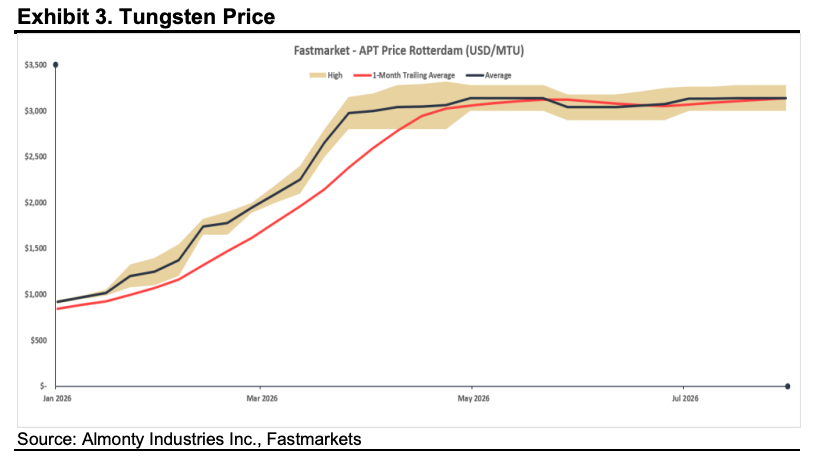
Slowly, more downstream companies are realizing that it is not only raw-material prices going up – the whole industry is in a real supply crisis.
The situation in Japan is especially severe. From last year, the tungsten trade between China and Japan came almost to an end, and since the start of 2026 no APT at all has been delivered from China to Japan. That has put Japanese hardmetal and tool producers in serious trouble.
In reaction to the missing Chinese raw material, Japan significantly increased its scrap imports over the last twelve months. Now, however, the USA – one of its main sources – has stopped the export of tungsten-containing scrap by imposing export restrictions. Some market participants say there is not yet enough recycling capacity in the US to process all the scrap it generates, so that without exports there could be an oversupply at home, and pressure on domestic scrap prices.
Some European and US tool producers are also complaining about shortages of raw material. Most confirm that, although they have had to raise their prices, demand for their products has not dropped – which is not surprising: nobody stops building cars or aircraft simply because the tools cost more. It confirms that tungsten demand, at least in the short and mid term, is not elastic to price.
We are in for a very interesting fall and winter.
Michael Dornhofer is founder of ISBP (Independent Supply Business Partner) in Graz, Austria. He has spent more than 20 years in tungsten, including 13 years at Wolfram Bergbau und Hütten, Sandvik’s tungsten business, and has worked as an independent agent and consultant to the tungsten and hard metal industry since 2019.
Running on empty
While everyone watches the defense story, you need to keep an eye on semiconductors too. There’s a gas called tungsten hexafluoride – WF₆. It’s what lays down the microscopic tungsten wiring inside advanced memory chips, the kind the entire AI boom is built on. No WF₆, no advanced chips.
Two Japanese producers, Kanto Denka and Central Glass, made about a quarter of the world’s supply between them. Past tense. As of the first of July, they stopped. Not an accident on the factory floor – they ran out of the pure tungsten powder they need, the powder comes from China, and China stopped letting it leave the country in 2025. The Japanese producers ran on stockpiles until the stockpiles were gone. Then so were they.
Samsung and SK Hynix are now scrambling to qualify new suppliers – normally a year-and-a-half job they’re trying to do in a hurry – and prices for the gas are being talked about 70 to 90 percent higher for the back half of the year.
So who’s filling the gap? China. A Chinese producer has already announced it’s expanding WF₆ capacity by a thousand tonnes a year. So: China restricts the raw material, the producers who depend on it go dark, and Chinese producers expand to serve the customers those factories just lost. Starve the competition, inherit the market. I’m not saying anyone drew it up that way. I’m saying it works whether they did or not.
Tungsten stopped being a mining story a while ago. It’s a memory story, an AI story, sitting a link or two up from almost everything you’re told is the future. It took two factories few people have heard of going quiet to show it.
Everyone’s got a tungsten project. Almost nobody’s got a tungsten mine.
Ask the strategic metals crowd to name the projects riding to the rescue and you’ll get a list that comprises real resources, mostly run by serious people.
Then ask which is producing tungsten today, and the room goes quiet. There’s one that went into administration a while ago, which wiped some of its permits, and it’s been clawing them back ever since. Even now it’s in a phased restart and the financing is still not closed. Elsewhere, there are some former Soviet holes in the ground that Moscow never finished, (China’s already taken the best one), and the New York Times had plenty to say about that operation. Then comes the investment decision, engineering, construction, commissioning. Nobody’s buying tungsten from there this decade.
I’ve bored you before on why tungsten resists going from deposit to metal, so I won’t again. What’s crucial is that Sangdong is processing – not next year, not after a study, running. When the whole field is measured in “targeted for 2027,” being the one name in the present tense is the difference between a supply chain and a slide deck.
Behind the Q2 numbers
I try to make this something more than just a company newsletter, but we reported Q2 this fortnight, the numbers are public, and they say something about the market, not just us. Revenue up 498 percent on the same quarter last year, and the business turned from burning cash to making it. One caveat I’ll flag myself: the headline $182m net income is mostly a non-cash accounting gain on our convertibles – real under the rules, but not money through the door. The operating number is the one that counts, and it’s finally real.
None of it came from Sangdong. Through the end of June the mine was still commissioning – it’s only been fully operational since July 1, after the quarter closed. So every dollar of that 498 percent came from existing operations at record prices.
What I’m reading
Tungsten leads critical mineral price gains
In the last edition I said tungsten wasn’t like the other critical minerals we all get lumped in with. Here’s the chart that proves it. Visual Capitalist ranked 27 of them by price move, using IEA data, and tungsten came out on top at 622 percent – more than three times the next metal on the list.
Scale is the easy story to sell
Two of the world’s biggest drug companies, AstraZeneca and Bristol Myers Squibb, reportedly talked about merging into one giant. The deal itself is normal enough. The reaction is the interesting part: AstraZeneca’s shares fell on the news. Investors looked at two big companies becoming one bigger company and asked the question the press release never does: what does the combined firm do well that neither could do alone? More revenue, more staff, more assets – none of that answers it. It just adds up to size. The Guardian has the story.
The AI boom sees a wobble
Almost every advanced chip in the world is made using machines from one Dutch company, ASML – nobody else could build them. Last week China reportedly built its own, breaking the monopoly. Markets panicked: chip shares fell worldwide, South Korea’s main index dropped 11.5 percent in a day, and Nvidia fell more than five percent and lost its place as the world’s biggest company to Apple. Sound familiar? It’s the concentration problem I keep going on about with tungsten – too much of something critical in one country’s hands, and everyone downstream exposed when that grip looks like slipping. Read more here.
Opinion
Ask a room of investors why tungsten matters now and you’ll hear one word: defense. Rearmament, drones, munitions, the bunker-buster headlines. It’s the stock answer. It’s also nowhere near the whole story.
Around 60 percent of US tungsten goes into cemented carbides – cutting tools, drill bits, the wear parts that chew through rock and steel. That’s the US Geological Survey’s number. Globally it runs close to two-thirds, a figure S&P Global’s recent market report puts in the same range. Defense and semiconductors matter – they’re why governments suddenly care – but by volume they’re the smaller part.
Defense demand is political. It moves with budgets and elections and it can stall the moment the headlines do. Industrial demand doesn’t work that way. As Michael notes above, when tool prices rise the buyers don’t stop – nobody halts a car plant because the cutting tools got more expensive.
So watch the geopolitics, but don’t mistake the loudest demand for the largest. The metal is going into the most ordinary work imaginable, and that’s why it isn’t getting cheaper.
* * *
Related Reads:
- China’s Tungsten Chokehold Turns Almonty Into a Critical-Metal Lifeline
- Taiwan Tech Insiders Warn Beijing’s Germanium Squeeze Is Hitting Production
Whether the chokepoint is tungsten, germanium, or other critical materials, China’s tightening grip on supply has brought our decoupling theme into sharp focus.
As Western governments accelerate efforts to reduce their dependence on Beijing, companies that control scalable, non-Chinese sources of critical minerals, processing capacity, and secure supply agreements are well positioned to become dominant players in the emerging industrial order.
Assets once thought of as just conventional mining operations are quickly becoming essential ex-China supply channels capable of bypassing Beijing and supporting Western defense, semiconductor, and advanced-manufacturing demand.
Almonty vs. Tungsten Prices
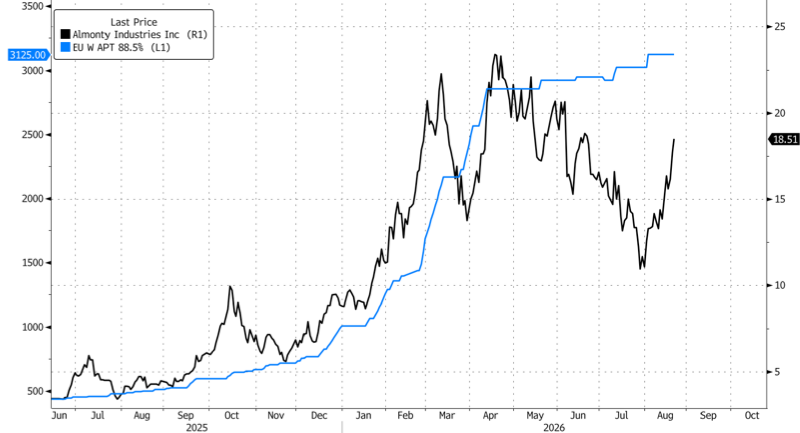
Yet, as Almonty Industries CEO Lewis Black emphasized above, tungsten is not solely a defense metal. It is also a critical input for the infrastructure powering the AI boom. Wall Street has yet to realize this fully – but they will.
Tyler Durden
Sun, 08/23/2026 – 19:50