
Please follow us on Truth Social, X, YouTube, Minds, Telegram, Rumble, GETTR, Gab, Instagram
South Korea is descending into chaos as a jailed president is facing the reality of a stolen election and an international body that is quietly exporting corrupt election systems and procedures to over 110 countries, with the clear fingerprints of the Chinese Communist Party on them.
South Korean ex-President Yoon Suk Yeol declared martial law almost exactly a year ago, in December 2024, stating that anti-state forces were bringing down a sovereign South Korean state. He was subsequently convicted and sentenced to seven years in prison on April 29, 2026. His supporters — and there are millions of them — believe that the prosecution was a politically orchestrated removal engineered specifically because Yoon had begun to expose the depth of CCP infiltration into South Korean state and corporate institutions. Massive crowds of pro-Yoon demonstrators gathered outside the Seoul courthouse on sentencing day, chanting “Our president, Yoon Suk Yeol.”
But that was not where the story ended. It was where it accelerated.
By the time South Korea held local elections on June 3, 2026, conservative voters were already suspicious of the early voting system. They determined to vote in person on Election Day, warning each other that early ballots could be diluted with fraudulent votes and manipulated by algorithm. When Election Day arrived, polling stations ran out of ballots. Voters who had waited in line were turned away. Officials told them that early voting had been their chance and that was all.
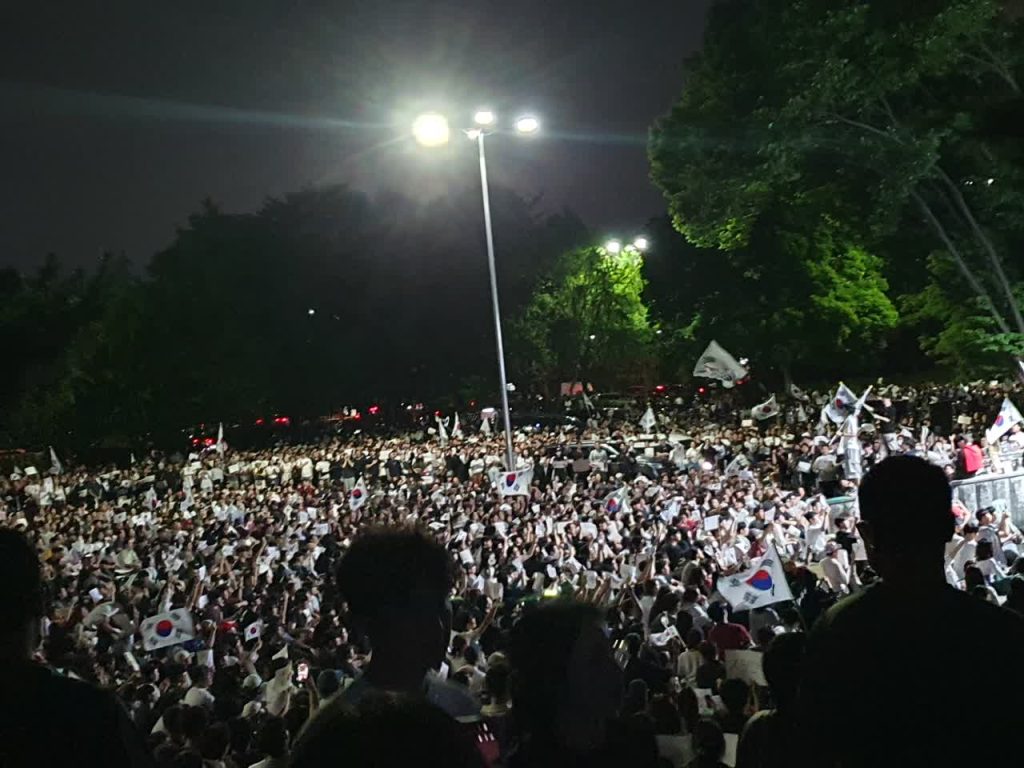
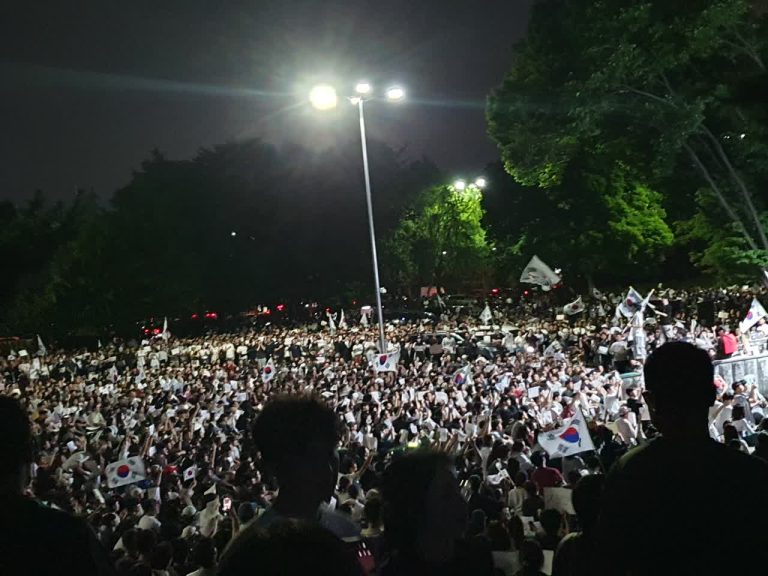
The protests that erupted have not stopped. More than two months later, demonstrators continue to gather daily at Olympic Park in Seoul, chanting “Hand count paper ballot, counted where cast, stop election fraud.” Independent analysts examining the ballot paper from those elections say the paper stock on a significant portion of ballots is measurably different from official ballot paper — consistent with large-scale printing by an outside party. Researchers estimate that as many as half of the 2.3 million ballots stored at the Olympic Park facility may be fraudulent.
Observers on the ground have also noted that police deployed to manage the protests include officers not recognized by local residents — who multiple witnesses say appear to be Chinese nationals embedded within South Korean law enforcement. The current South Korean government has advanced legislation that would allow up to 10 million Chinese nationals to relocate to South Korea annually over the next decade — extraordinary for a nation of only 50 million.
At the center of the deeper story is an organization almost no one in the Western press has examined: the Association of World Election Bodies, or A-WEB.
A-WEB was founded in October 2013 in Songdo, South Korea, created and funded by South Korea’s National Election Commission. It has grown to include election bodies from more than 110 countries. On the surface it is a technical assistance organization — training election workers, sending experts abroad, modernizing election infrastructure. That modernization almost always means systems built by a South Korean company called Miru Systems: voting machines, ballot scanners, and election management software. Countries that received Miru equipment through A-WEB’s programs include Iraq, the Democratic Republic of Congo, the Philippines, Kyrgyzstan, and multiple nations across Latin America and Asia. In several of those countries, contested results, demands for hand counts, and fraud allegations followed.
Independent security audits of South Korea’s own NEC election computers — the same systems A-WEB promotes abroad — revealed critical vulnerabilities in 2023: weak passwords, unauthorized access pathways into voter rolls, and the technical ability to alter vote totals or generate fraudulent ballots remotely. A-WEB’s programs were also partially funded through USAID before those operations were curtailed under the Trump administration — meaning American taxpayer dollars flowed into what independent researchers now describe as a global election manipulation pipeline with CCP influence at its core.
South Korea is not merely another regional flashpoint between the United States and China. According to investigators who have spent years on this story, it is the prototype. The election systems, the institutional penetration, the embedded operatives, the legal architecture that prevents challenges to results — all of it was developed and tested in South Korea first. Then exported through A-WEB to over a hundred countries around the world.
The people in the streets of Seoul know exactly what they are fighting. The question is whether anyone in Washington is paying attention.
‘NO AD’ subscription for CDM! Sign up here and support real investigative journalism and help save the republic!