Trump ‘May Keep Going’ With Strikes As Iran Took ‘Too Long’ To Negotiate Deal, Must ‘Pay The Price’
Summary
- Trump tells Fox he “may keep going” with strikes.
- Trump says Iran took too long to negotiate, and now “will have to pay the price”.
- Tehran claims prior night attacks in Kuwait, Bahrain and Jordan as fulfilment of its previously vowed ‘retaliation’ – targeted the Fifth Fleet headquarters in Manama, footage shows.
- Iran again signals it could cut off all indirect talks & any negotiations, says it is ‘reviewing’ US talks after latest exchange of missiles.
Yes 18% · No 83%
View full market & trade on Polymarket
* * *
Could ‘Keep Going’ With Strikes: Trump to Fox
More strikes coming? Trump is certainly strongly hinting at this, and yet an overall strategic vision still remains murky and ill-defined. Once again he in a short 12-hour period went from hyping a deal being a few days away, to now threatening yet more attack waves on Iran, in wake of last night’s:
President Trump said Wednesday that he’s close to ordering more strikes on Iran after the country’s attacks targeting American bases in Persian Gulf nations, according to Fox News’ Trey Yingst.
Mr. Trump said he “may keep going” with strikes, which he said would target power plants and bridges, because Iranian negotiators are “tapping the United States along,” according to Yingst.
He wrote on Truth Social just before these comments that Iran will have to “pay the price” after taking too long to proceed with negotiations.
Trump: Iran Took Too Long To Negotiation, Now Will ‘Pay’
As part of what the United States is calling its latest ‘defensive strikes’ after Iran shot down an Apache helicopter in the Hormuz region, American forces overnight into the early Wednesday hours targeted “air defense, ground control stations, and surveillance radar sites” – the Pentagon said. Iran confirmed that there were indeed fresh attacks around Bandar Abbas and Qeshm Island, but gave no details on the damage, or info on other strikes potentially conducted elsewhere across the Islamic Republic.
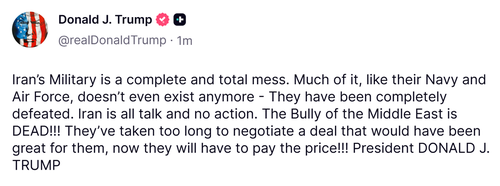
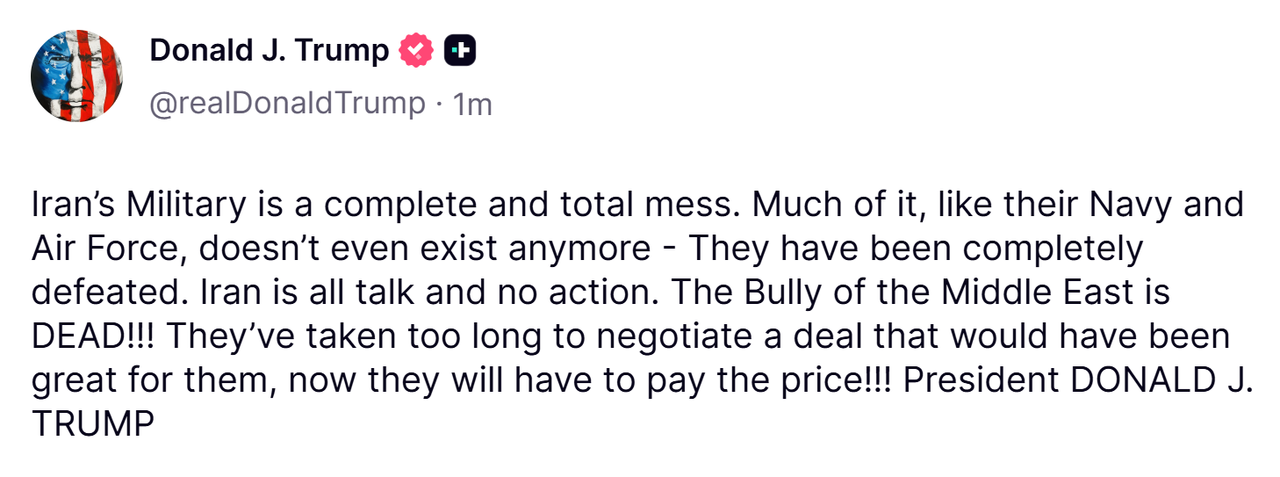
“The operation was a proportional response to recent attacks on U.S. forces and international commercial ships transiting regional waters,” US Central Command (CENTCOM) said. Trump is meanwhile again lashing out at Tehran, claiming its military is now a “complete and total mess” – and yet it keeps responding:
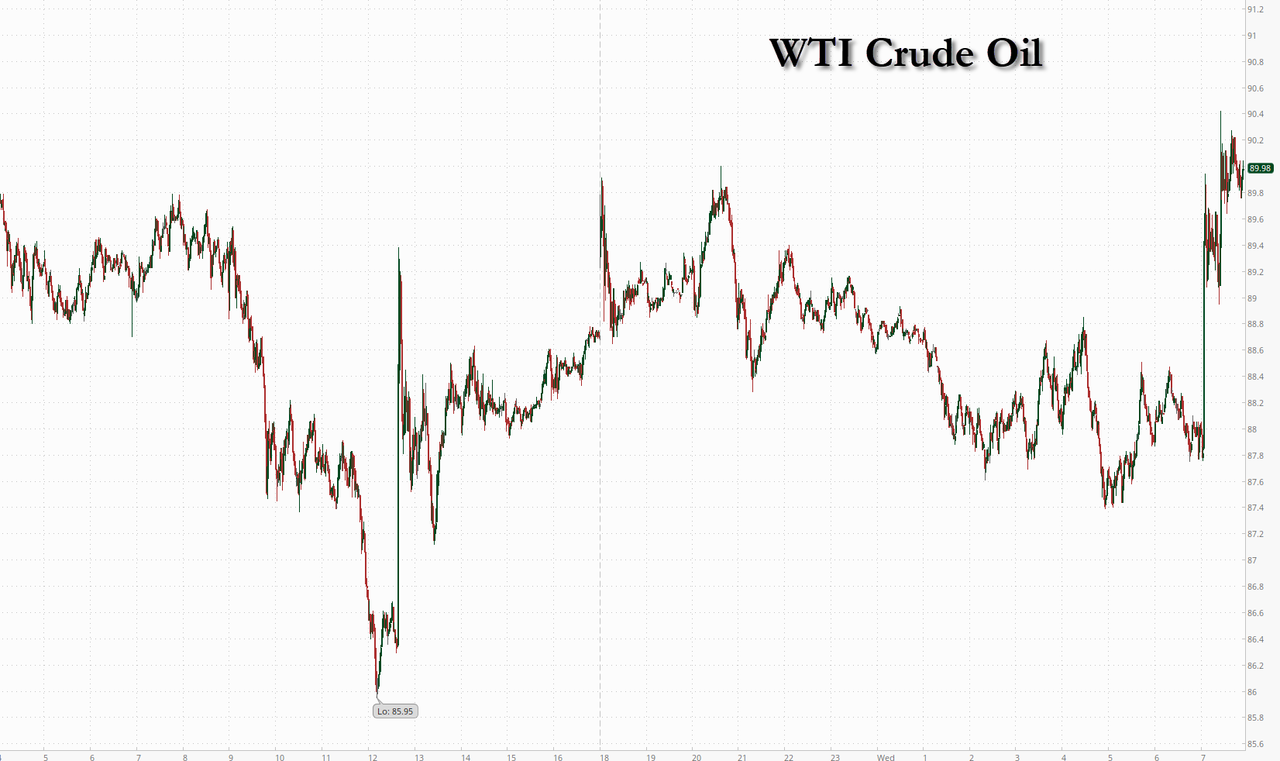
Oil reacts, sensing no peaceful off-ramp or de-escalation on the horizon…
Kuwait, Bahrain, Jordan Hit Hard by Iranian Overnight Attack
Tehran later claimed attacks in Kuwait, Bahrain and Jordan as fulfilment of its previously vowed ‘retaliation’ – and given these countries host American forces. This marks merely the second time this week the ceasefire was ignored (or rather, shattered – though the White House is maintaining it’s still on) with major tit-for-tat strikes, as each side asserts that it is acting ‘defensively’.
Iran has been saying it’s going to keep up the pressure on Washington and its Gulf allies through both the ‘battlefield and diplomacy’ – with Iran’s Foreign Ministry spokesperson Esmaeil Baghaei freshly charging that the US is “undermining” the diplomatic process through “contradictory messages, frequent shifts in its positions and demands, as well as repeated violations of the ceasefire.”
He indicated that at this point there’s not even the “minimum level of conducive conditions” that is “required in order to carry out diplomacy effectively.”
Bahrain and Kuwait got hit hardest in these newest strikes, with reports saying the US Fifth Fleet base came under fire:
BREAKING: Footage shows a ground-level explosion in Manama, Bahrain from an Iranian missile strike in the direction of the US 5th Fleet HQ minutes ago, with up to 20+ separate explosions now reported across the city. pic.twitter.com/LCHlZBGKra
— The Hormuz Letter (@HormuzLetter) June 10, 2026
Iran Touting Both ‘Diplomacy & the Battlefield’
“The Zionist regime is also damaging this process through its repeated violations of the ceasefire in Lebanon,” Baghaei said, adding “any diplomatic process is harmed by the use of force and unlawful actions.”
“Diplomacy and the battlefield are not separate matters. Together they serve as instruments for safeguarding Iran’s national interests and security,” he stressed in a familiar refrain of late.
He also indicated the question of negotiations will be “reviewed” in light of last night’s developments, and further emphasized, “Wherever necessary, our armed forces will respond to the enemy with authority.“
Only when you see it with your own eyes you start to appreciate how impressive a salvo of 10 Kheybar-Shekan Aero-Ballistic missiles is…
(especially when timed on purpose at dawn) pic.twitter.com/6JpTRBvBHW
— Patarames (@Pataramesh) June 10, 2026
“Every Side Believes They Can Control the Escalation”
But it’s also clear Tehran feels it must assert strong red lines immediately and without hesitation if it is to survive this now several months-long military confrontation with Washington. On this, longtime regional war correspondent and analyst Elijah Magnier has some insight as to each side’s calculus:
Speaking to Al Jazeera, Magnier said it’s a volatile situation with no “stable political exit” as peace is far from being achieved while Lebanon and Gaza remain outside of any final settlement.
“The most dangerous thing is that every side believes they can control the escalation. However, a repeated incident can erode restraint, and if talks collapse completely, this controlled escalation could widen into a much larger conflict,” he said.
History has shown if “one strike crosses the red line” the attacks can spiral out of control, said Magnier.
Indeed in many ways that’s how we got here in the first place.
Vital water infrastructure reportedly struck in Iran during this new round of intense but brief escalation:
U.S. military strikes reportedly hit drinking water storage tanks in the Bamani district of Sirik county, Hormozgan province, Iran. pic.twitter.com/GMw8Ha9DaH
— Clash Report (@clashreport) June 10, 2026
The White House believed it could control the outcome from day one of Operation Epic Fury, and then perhaps a bit of panic set among US officials in when it was realized the government in Tehran would not so easily fall, and that the military apparatus would become hardened, and its power expanded.
Reports of another US MQ-9 Reaper drone shot down over Iran:
Footage of U.S. MQ-9 Reaper falling down over Jam county, Bushehr province, Iran after it was hit. https://t.co/nJHBkyF2cz pic.twitter.com/99evGPBrgm
— Clash Report (@clashreport) June 10, 2026
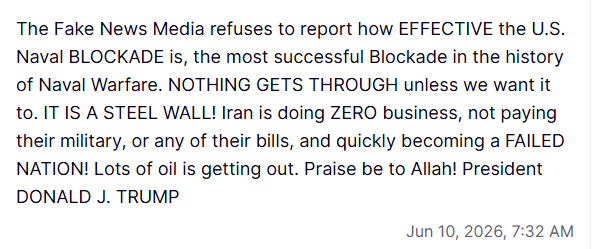
From there it took many weeks to get the naval armada in place, enough to where a blockade could be enacted against Iran’s ports and its crucial oil exports. The White House continues to face several ‘bad’ and ‘worse’ options for dealing with the crisis, as energy prices are set to soar this summer.
More Latest Developments
via Newsquawk…
- US President Trump told ABC that the US was responding to Iran and that it is important to respond to Iran downing the helicopter, as well as noted that the response is very strong and powerful.
- US VP JD Vance said the US is very close to reaching a deal that would address Iran’s nuclear programme for the long term, which could come next week or months from now, but absolutely before the midterms, according to CBS.
- White House senior official said nothing has changed in their position regarding an agreement with Iran and it is still close despite the strikes.
- A US official said the US military carried out strikes on almost 20 targets inside of Iran, but noted preliminary assessments indicate most Iranian missiles and drones were successfully intercepted.
- Iranian Foreign Ministry spokesperson Baghaei said they need to reassess, following the overnight clashes, when questioned on talks with the US, SNN reported.
- Iranian Foreign Ministry statement strongly condemns America’s crime in its military aggression against Iran.
- An Iranian military source tells IRIB that no offensive military operations have been conducted in the Strait of Hormuz over the past 24 hours. Warned that if the enemy carries out another hostile action under the pretext of the military helicopter crash, it will face a decisive response.
- A massive fire in the centre of Erbil and an explosion has been heard near the US base in the vicinity, Mehr news reported citing sources.
- Local sources reported that an explosion was heard in the area of Qeshm city, Mehr News reports. However, this was later denied by the Qeshm governor.
- UN Security Council debated reviving the Iran sanctions panel, although Russia and China opposed the revival of the Iran sanctions committee, according to Tasnim.
- Israeli air raids hit the Lebanese towns of Touline, Srifa and Kafra. It was separately reported that missiles were spotted from Lebanon that were headed towards Kiryat Shmona and its surroundings, while rockets launched from Lebanon towards Upper Galilee were also detected.
- UKMTO has received a report of an incident 20nm Northeast of Oman’s Sohar.
- UKMTO reported an incident involving a cargo vessel 88 nautical miles southwest of Balhaf, Yemen.
Tyler Durden
Wed, 06/10/2026 – 09:15