What Is the Trump Administration Really Trying To Do With The Latest Comey Indictment?
On Tuesday, a federal grand jury in the Eastern District of North Carolina handed down a two-count indictment against the former FBI director James Comey, charging him with threatening the life of President Donald Trump and transmitting that threat across state lines.
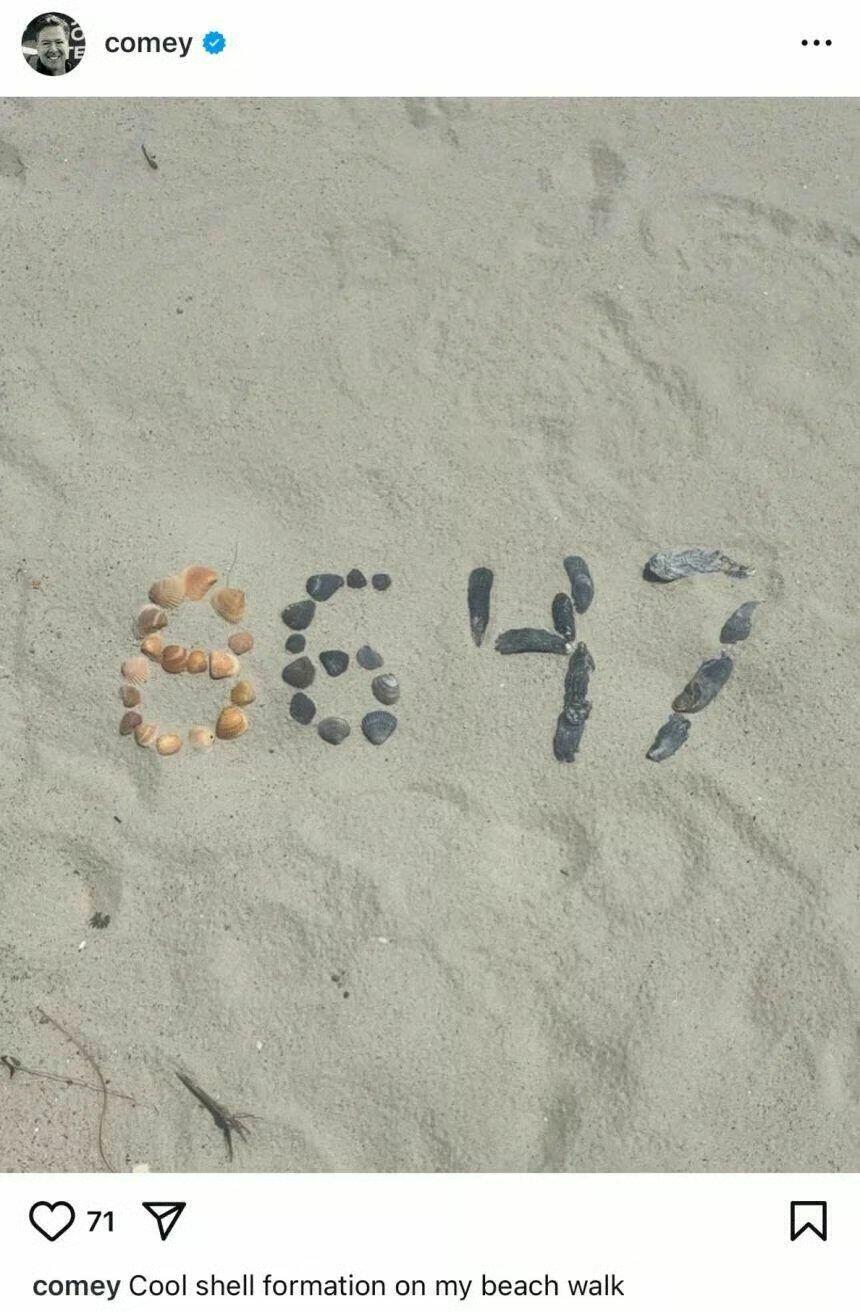
The basis for the charges: an Instagram post from May 2025 in which Comey shared a photo captioned “Cool shell formation on my beach walk.” The shells on the sand spelled out “86 47.” Each count carries a maximum of ten years in federal prison.
Comey deleted the post the same day it went up and issued an immediate clarification on social media. “I didn’t realize some folks associate those numbers with violence,” he wrote. “It never occurred to me, but I oppose violence of any kind, so I took the post down.” He later told interviewers that he and his wife had simply spotted the formation during a stroll along a North Carolina beach and read it as a quirky, possibly restaurant-themed joke. Despite the dubious explanation, from the moment the post became controversial, legal analysts were skeptical that a case against him was possible.
There still appears to be bipartisan agreement on this point.
“It’s a seashell case, nine, ten months old, and it will never go anywhere,” Joe Scarborough said on MSNOW’s Morning Joe. “It will have the opposite impact, and they’ll get laughed out of court.”
Constitutional scholar Jonathan Turley, one of Trump’s more reliable legal allies, agreed the case has little legal merit, despite the indictment.
“To convict Comey, the Justice Department will have to show that his adolescent picture was a ‘true threat’ under 18 U.S.C. § 871 and § 875(c). It is not.” He went further, invoking the founding era: “This nation was founded in rage. The Boston Tea Party was rage. In forming this more perfect union, we created the world’s greatest protection of free speech in history.” Not exactly a ringing endorsement of the prosecution’s theory.
First Amendment protections for political speech are remarkably broad. Under Brandenburg v. Ohio, the Supreme Court held that the government cannot punish inflammatory speech unless it is “directed to inciting or producing imminent lawless action and is likely to incite or produce such action” – a standard that has shielded provocateurs far more combustible than a retired FBI director posting a picture of seashells.
Former CNN analyst Chris Cillizza has his own theory about what is really behind this latest indictment. According to Cillizza, Trump is less concerned about whether Comey goes to jail than he is with just making Comey’s life miserable.
“It’s impossible to separate both of those indictments, the one in September and the one today, from Donald Trump’s absolutely repeatedly expressed belief that the Department of Justice exists to target and punish his political enemies,” Cillizza mused. “Now, again, whether they would actually be guilty in a court of law, we shall see, but to punish these people. So we saw Comey indicted in September 2025, since dropped. We saw Letitia James, another big political enemy in Donald Trump’s mind of his, also indicted, charges dropped. We’ve seen John Bolton, the, a major Trump critic, indicted, and now we see Comey indicted again.”
Donald Trump doesn’t really care if Jim Comey goes to jail.
He just wants to make Comey’s life miserable for as long as possible. pic.twitter.com/7wsHW32kGp
— Chris Cillizza (@ChrisCillizza) April 28, 2026
Cillizza gets some things wrong here. The Letitia James and the previous Comey case were tossed by a Clinton-appointed judge who claimed that the Justice Department illegally appointed the prosecutor who brought the charges at President Donald Trump’s urging. They were not tossed on the merits.
Is Trump trying to make life difficult for his enemies? Acting Attorney General Todd Blanche pushed back on this suggestion on CBS Tuesday, insisting the administration had been investigating the matter for nearly a year and that a grand jury – not the White House – returned the indictment. “Of course not, absolutely, positively not,” Blanche said when asked whether Trump directed the charges. The indictment itself argues that a “reasonable recipient who is familiar with the circumstances” would interpret the shell arrangement as a serious expression of an intent to do harm to President Trump. That framing will be tested the moment a federal judge reads the First Amendment.
There is a certain irony lodged in all of this. Trump spent years – genuinely – defending himself from what he called a weaponized justice system. The Russia investigation, the two bogus impeachments, the civil fraud trial in New York, the classified documents case, the January 6 prosecution: whatever one thinks of any individual charge, the cumulative weight of it was real and politically motivated in ways that even Trump’s critics occasionally acknowledged.
But out of those assaults, the president emerged convinced that the DOJ had become a political instrument and that the only way to respond was to go after those who abused their power in the first place.
The trouble is that a seashell photograph does not make for a compelling demonstration of that principle. There are documented, substantive cases to be made against Comey – his handling of the Hillary Clinton email investigation, his unauthorized leaking of memos to the press, and his role in initiating the surveillance of a sitting president’s campaign. Those are the cases that would survive scrutiny, attract serious legal arguments, and perhaps hold up before a jury. Instead, the administration is going to federal court over a photo of seashells.
Blanche said Tuesday, “If anybody in this country thinks … that it is okay for anybody to threaten the president of the United States … then we have a bigger problem than I even imagined.” That may be true. But first you have to prove the threat was real – and that argument, and experts on both sides aren’t seeing how this meets that standard.
Tyler Durden
Thu, 04/30/2026 – 18:50