Intel Shares Soar On Strong AI-Fueled Outlook, Surpassing August 2000 Peak
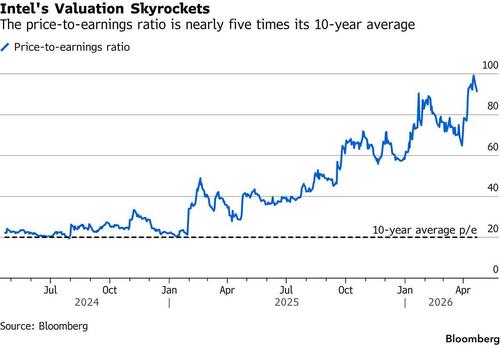
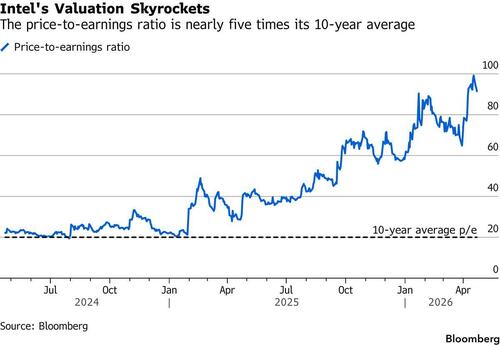
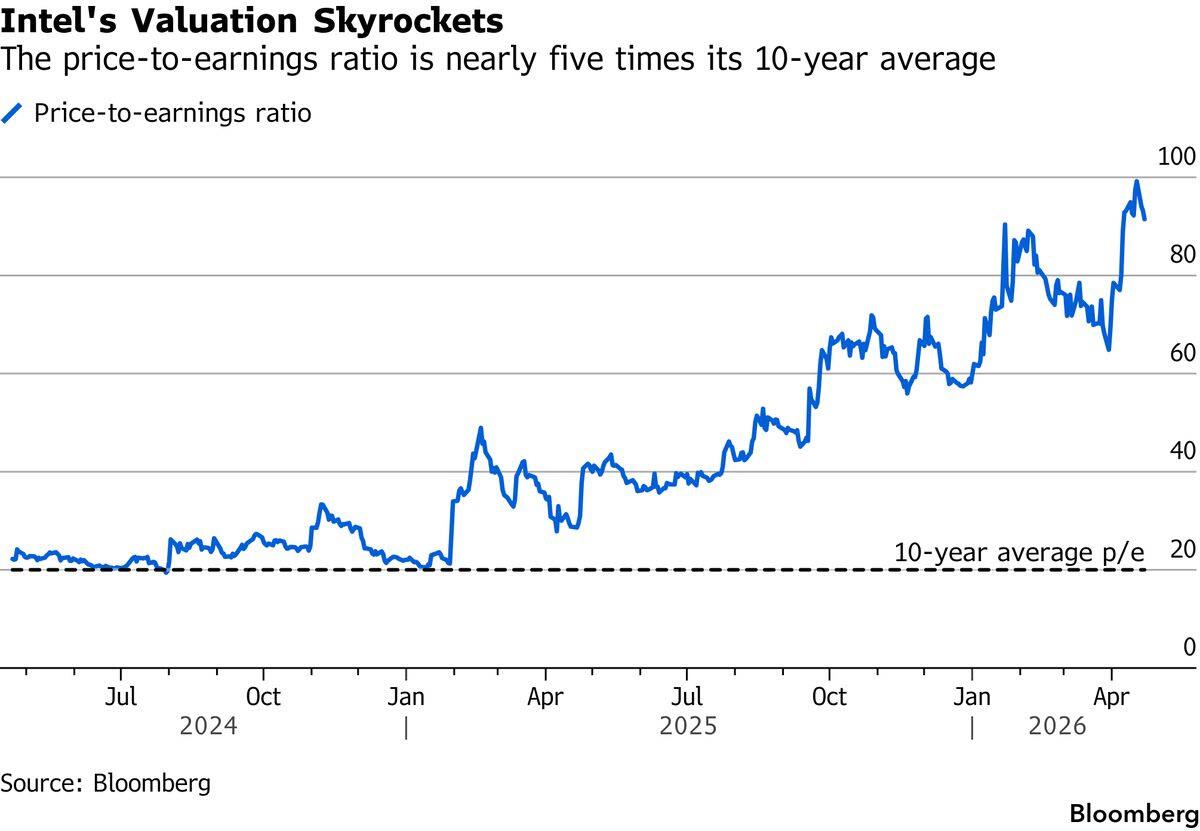
Chipmaker Intel, which less than a year ago was trading like a distressed company, and required a capital infusion from the US government, and earlier today hit a 90x forward PE…
… soared after hours after giving a strong sales forecast for the current period, signaling that the recently struggling chipmaker is finally beginning to benefit from the giant build-out of artificial intelligence infrastructure. But before we get there, here is a quick look at what the company reported for the first quarter:
- Adjusted EPS 29c vs. 13c y/y, beating estimate 1.0c
- Revenue $13.58 billion, +7.2% y/y, beating estimates of $12.36 billion
- Intel Products revenue $12.78 billion, +8.7% y/y, beating estimate $11.53 billion
- Client Computing revenue $7.73 billion, +1.3% y/y, beating estimate $7.1 billion
- Datacenter & AI revenue $5.05 billion, +22% y/y, beating estimate $4.41 billion
- Intel Foundry revenue $5.42 billion, +16% y/y, beating estimate $4.81 billion
- All Other revenue $628 million, -33% y/y, beating estimate $605.3 million
- Intersegment eliminations revenue -$5.25 billion, -12% y/y
- R&D expenses $3.38 billion, -7.3% y/y, beating estimate $3.18 billion
- Adjusted gross margin 41% vs. 39.2% y/y, beating estimates of 34.5%
- Adjusted operating income $1.67 billion vs. $690 million y/y, beating estimate $386.2 million
- Adjusted operating margin 12.3% vs. 5.4% y/y, beating estimate 3.08%
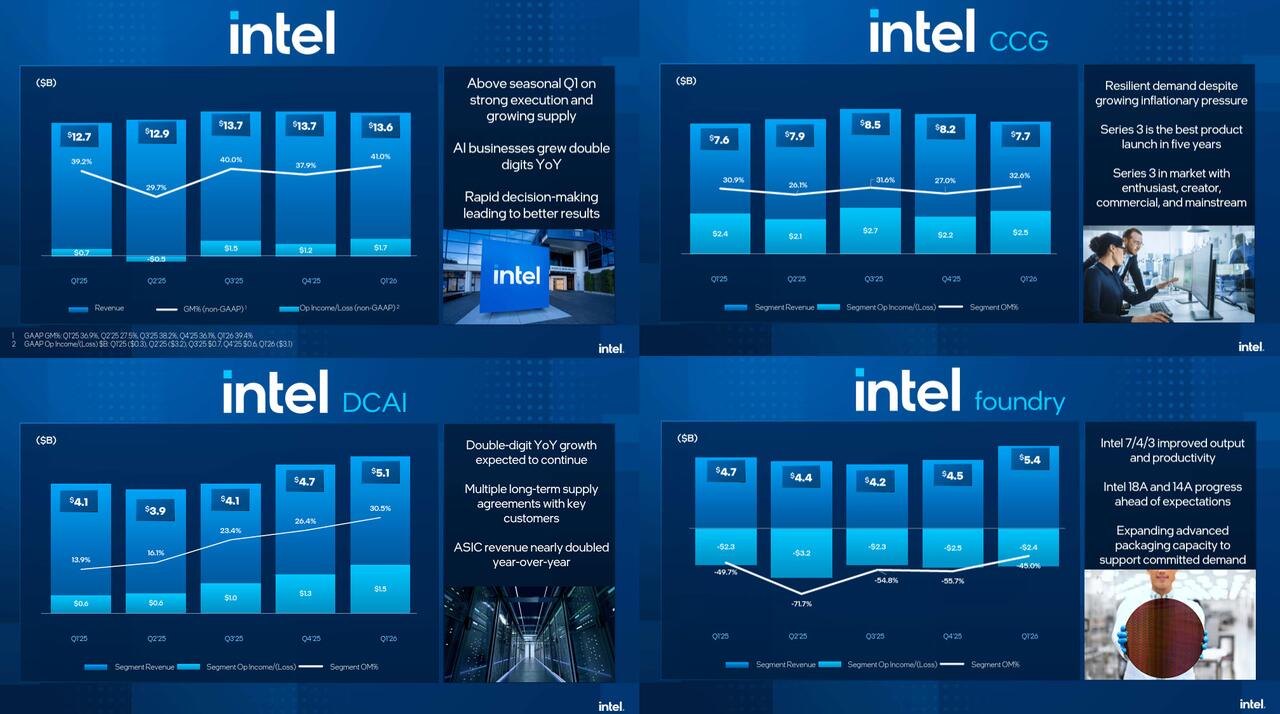
The Intel Foundry Services division – the company’s factory unit – generated revenue of $5.4 billion, up 16%. That unit currently relies almost exclusively on Intel product divisions for orders, though it is seeking outside customers. Its PC chip division had revenue of $7.7 billion, and the data center unit posted sales of $5.1 billion. All of those totals topped Wall Street estimates. Gross margin was 41% on an adjusted basis. When Intel was at the height of its powers, it regularly reported margins north of 60%. It predicted a margin of 39% in the current period.
Commenting on the results, CFO David Zinsner said that “we remain focused on maximizing our factory network to improve available supply and meet our customers’ needs throughout the year.“
CEO Lip-Bu Tan chimed in: “The next wave of AI will bring intelligence closer to the end user, moving from foundational models to inference to agentic. This shift is significantly increasing the need for Intel’s CPUs and wafer and advanced packaging offerings.”
While Q1 results were solid, especially at the data center level, it was the Q2 forecast that caught the market’s attention:
- Revenue will be $13.8 billion to $14.8 billion in the quarter ending in June, beating estimates of $13 billion.
- Adjusted EPS will be about 20 cents a share, also beating estimates of 9 cents.
- Margin is projected to rise to 39.0%,
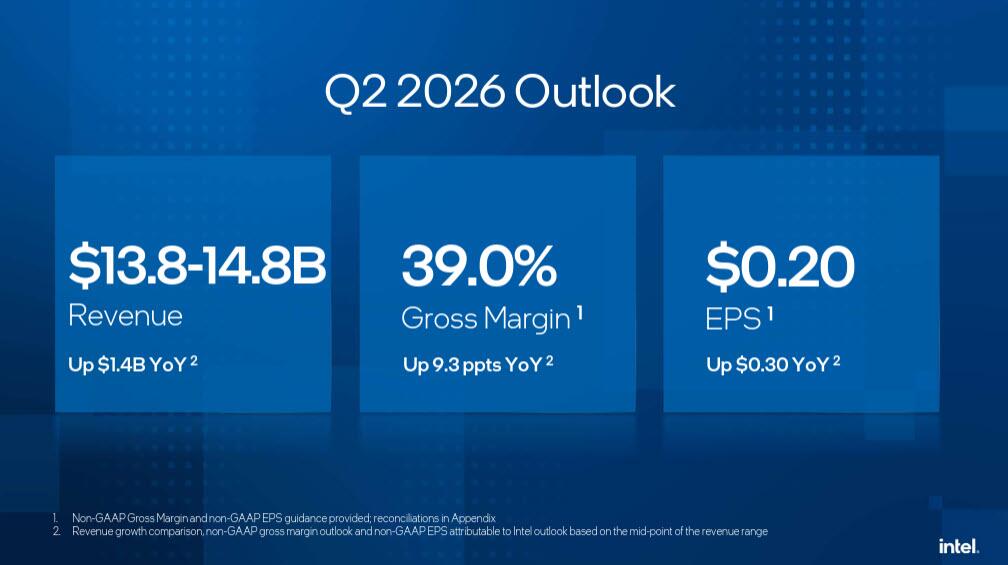
The upbeat outlook suggests that CEO Lip-Bu Tan is making progress on a challenging comeback plan. After lining up major investments in Intel last year which helped to strengthen the company’s balance sheet – Thursday’s results suggest he’s now delivering on a promise to improve its operations.
The earnings report shows that the need for data center chips to power the massive AI expansion is lifting demand for Intel’s flagship Xeon server processors. That type of generalist semiconductor is a renewed focus for companies trying to turn their AI software into services that bring in revenue.
In an interview with Bloomberg, Tan said Intel delivered a “solid result” that was ahead of its projections. He expects the strong demand for processors used in AI systems to expand and said the company is “laser-focused” on increasing output from Intel’s factories, which still can’t produce enough to fill all its orders.
“There is huge demand,” Tan said. “We are working very hard with our team to make sure we deliver, that we meet that demand but we are still short because the demand keeps increasing from the customers.
And, as Bloomberg notes, for now Intel has also been able to navigate another challenge the PC industry is facing: memory-chip shortages.
To be sure, the company has a long way to go to restore its former chip-industry glory. Its annual revenue of $53 billion last year was roughly $25 billion shy of the company’s peak revenue, achieved in 2021, when the stock was far lower. Wall Street projects 3% growth in 2026.
Red-hot demand for server products has lured memory suppliers into concentrating on the high-speed processors for those machines. That’s cut into production of standard products used in phones and personal computers, meaning fewer of those mass-market devices are being built and the prices are going up.
In addition to making progress on production, Tan has restored Intel’s balance sheet via outside investments – to the point where the company bought back part of a factory in Ireland that it had been forced to sell to raise cash. That purchase was seen as a sign of future confidence by investors. Adding to the optimism, Tesla CEO Elon Musk said Wednesday that he will use Intel technology as part of his effort to build an in-house chip manufacturing plant. Tan declined to provide further details on the relationship.
Finally, Intel said it would spend more than originally budgeted on capex, according to CFO Dave Zinsner. The company has plenty of factory space and will add more machines to fill it out, he said. Capital expenditures will now be about flat from where they were last year. Intel had earlier said it planned to reduce its outlay.
In response to the strong earnings and guidance, Intel shares rose 14% in extended trading. The stock had gained 81% this year before the results were released, closing at $66.78. This has now pushed the company’s fwd PE well above 100x.
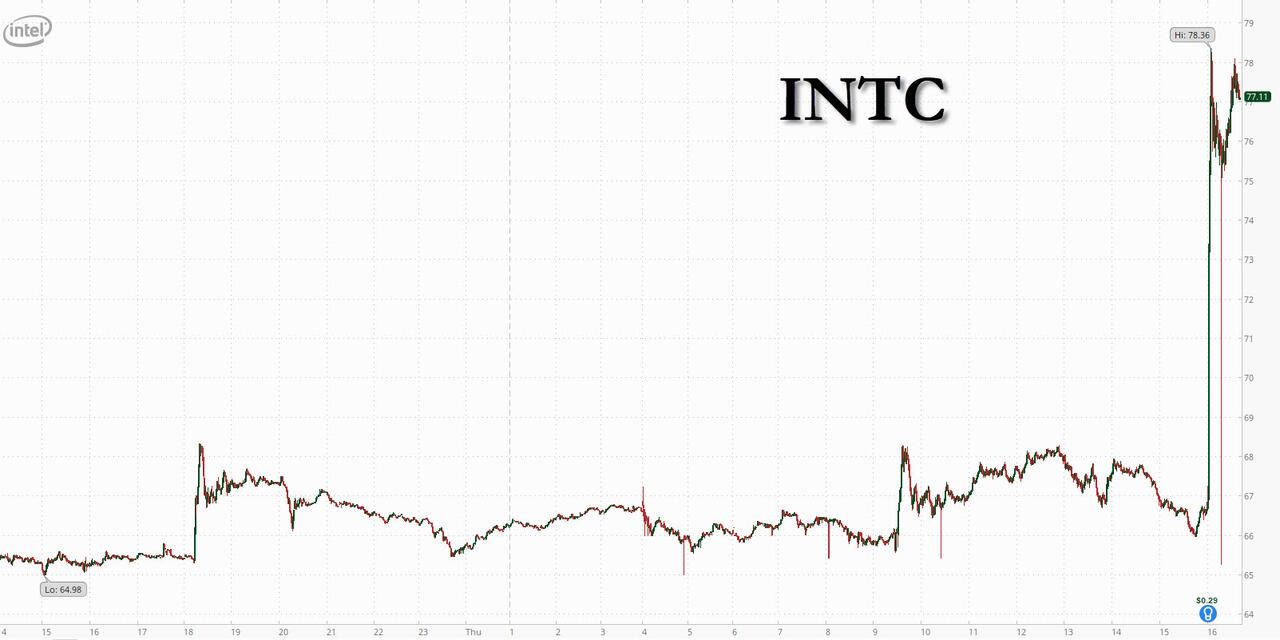
With the 14% surge after hours, Intel stock has finally surpassed its dot com bubble high of $74.88 hit in August of 2000.
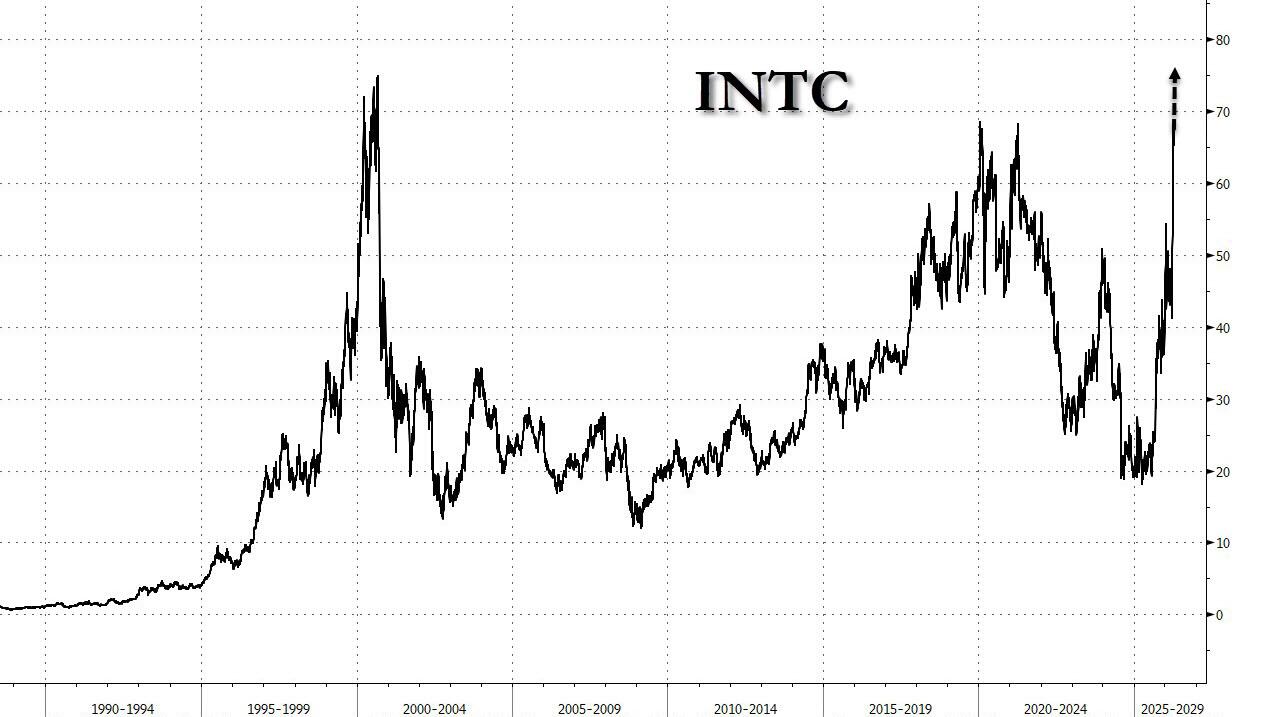
As Shay Boloor writes, “all it took was a CPU shortage, AI agents, SpaceX + TSLA terafabs and a bit of help from the U.S. government + NVDA.”
Tyler Durden
Thu, 04/23/2026 – 16:46